

Morgan's Belle
A Portrait of Belle da Costa Greene
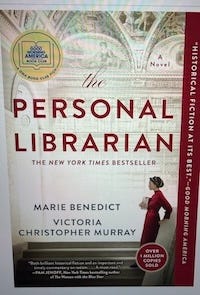
The Wednesday meeting of the Storied Sisters Society is now called to order.
January is WWI Era Month
Today we celebrate Belle da Costa Greene of The Personal Librarian by Marie Benedict and Victoria Christopher Murray. Even though World War I is a third act backdrop in this book, Belle is very much a creature of the time with one foot in the Victorian Era and one in the emerging Roaring Twenties.
Belle is a rule breaker and a risk taker who lives in fear. As a young professional woman passing for white, she goes to work for JP Morgan to build his library. She says: “The library is dedicated to memorialize the physical history of the book.” The ambition in this deceptively simple statement is breathtaking. Belle set out to change history but ending up making it. She forged a small revolution of her own to share with the world, against crushing odds and enormous personal sacrifice. Not bad for a life’s work.
The Moxie Meter: So far in our meetings, we’ve never had a professional powerhouse like Belle. Her dazzling erudition is, if anything, downplayed. Besides her brilliance, she intuitively understands what we would now call branding. Through her fashionable clothes and coiffed hair, she positions and presents herself. She uses all means to shine in the salons of the rich, in the media of the day, and in her professional circles. Belle crosses a threshold the first time she bids at auction for Mr. Morgan. A competitive ferocity that she never knew she had, is unleashed, never to be sheathed again.
The Way into the Book: It is Belle’s mother who runs the show at the beginning, even though Belle narrates. The deception is originally authored by her mother, though Belle is clever enough to improvise her charade on the fly. Her mother is the taskmaster who makes Belle study at midnight after a taxing social event and rationalizes it by sitting with her.
Why We Love Her: Belle has confidence and relishes her work but can’t celebrate the joy of her success. She is constantly hemmed in by anxiety and fear over her secret. It is a high price that is required of Belle, one she doesn’t deserve. It robs her of the simple peace she never attains. How can we not sympathize with a young woman shouldering such extreme sacrifices and responsibilities. That she does so with such grace and gallantry makes us want her for a friend.
Why We Question Her: She frequently put others before herself, especially Mr. Morgan and her family. Perhaps this constant sacrifice adds to her justified feeling of anger and resentment from already living a double life. It could have contributed to her tendency to occasionally drink too much or be intentionally provocative in riling up her elite social circle. Being “a woman without a country” was an isolating, difficult fate that was sometimes too much for Belle.
Also, her love interest Bernard was something of an Achilles heel, as she accepted abandonment, cheating and lying from him, but finally drew the line at theft.
Her Paradoxes:
1) Belle calls Washington DC home even though it’s a distant, brief memory. It is because it was the only place where Belle lived an authentic life.
2) Belle eloquently describes her own dilemma, “A colored girl named Marion Greener could never get the job of working for Mr. J P. Morgan, only a white girl named Belle de Costa Greene could.”
3) She’s already 16 years old with presumably some opinions of her own when the father leaves. However, Belle never seems to question having whiteness foisted on her by her mother.
4) Belle is so enmeshed in the past that she is literally ignorant of the present, like that she has a suffragette following from being featured in the press.
5) Belle is dependent on her sisters as her “white” escorts to help her pass because the one time she took her brother, whose skin matches hers, she was questioned.
6) One of the steeper prices Belle pays to have the life she wants is that she lets Bernard lie to her. Was it because she lied to herself?
Her Superpower is: Belle is a prodigy. JP Morgan had been studying the fine arts and letters market for 50 years, but in her mid-twenties Belle knows more. She builds the worlds’ preeminent library collection in only 6 years and then improves on it for the rest of her life. She continually bests the leading experts worldwide in procuring the most coveted prizes.
From Leading Lady to Heroine Moment: “It was that intimate conversation about the past that provided the connection between Mr. Morgan and me.” Yet by her own admission, Belle filled a void in Morgan’s heart. They have moments of attraction, like when Morgan says she’s pretty and compliments her grey eyes. It continues for years, but always they agreed that their joint mission of the library comes first.
The day comes when Morgan makes his intentions obvious, and she finally spurns him for real. Morgan turns on Belle and the relationship never recovers. Even though she must now operate in an adversarial environment, her commitment does not waver. Not even Mogan’s ire and obstruction will deter her.
Self-Starter Quotient: Belle comes out of the gate a warrior. She even describes herself in warlike terms, referring to “Her armor of wit and humor” and having a “barricade of romantic feeling erected.” Her ability to compete runs deep, “I feel power surge through me, having intellectual prowess and financial dominance over a man.” You go, Belle!
Themes the Book Alludes to: Racism, gender equality, capitalism, the art market, social stratification, betrayal, family.
What the Book Is Ostensibly About: A woman, passing for white, helped build the Morgan Library in the early 1900s in New York City.
What the Book Is Deeply About: Family. Belle lost one father but found another in Mr. Morgan. His death led her back to her original father. To reclaim him she says, “In order to move forward I must go back.”
Knowing she will be carrying the financial burden of her real sisters forever, Belle even makes peace with her ersatz sister, Anne Morgan. They finally agree their secrets are safe with each other. The only true companion Belle has in life is her mother, her co-conspirator of deception, to whom she is cleaved until death.
What I Took Away: What did Belle want? At her first elite social event at the Vanderbilt mansion, Belle sees people of color serving the party and says to herself, “I wish that in some small way my accomplishments will give them hope.” My takeaway is that this simple wish informed her life and career as much as building the Mogan Library for posterity. Though Belle could never embrace her people publicly, everything she did was for them. She says that she never forgot that each night went she went to bed she turned back into Marion Greener. Deep thanks to our authors for this amazing true story: Marie Benedict and Victoria Christopher Murray.
Our Storied Sisters Society Code:
We honor the women of the past who endured so the women of the present can prevail.
On a personal note, I’m delighted to share the cover reveal of my upcoming epistolary historical fiction novel debuting this spring, Dear Missing Friend.

I've read about ten of Marie Benedict's books, including this one.